In today’s ever-evolving world, it’s essential to keep up with the myriad of slang words that emerge, particularly with the increasing influence of social media and the internet. As language constantly evolves, new slang words are created and adopted by people from various generations and cultures. This page will provide a comprehensive list of slang words from A to Z, accompanied by their meanings so that readers can both expand their understanding and stay in-the-know.
Slang Words
What Is Slang?
Anyone who has ever learned another language knows that you begin with the basics: verb tenses, common phrases, grammatical structure, word syntax. That’s because you have learn all the rules before you can break them.
Right?
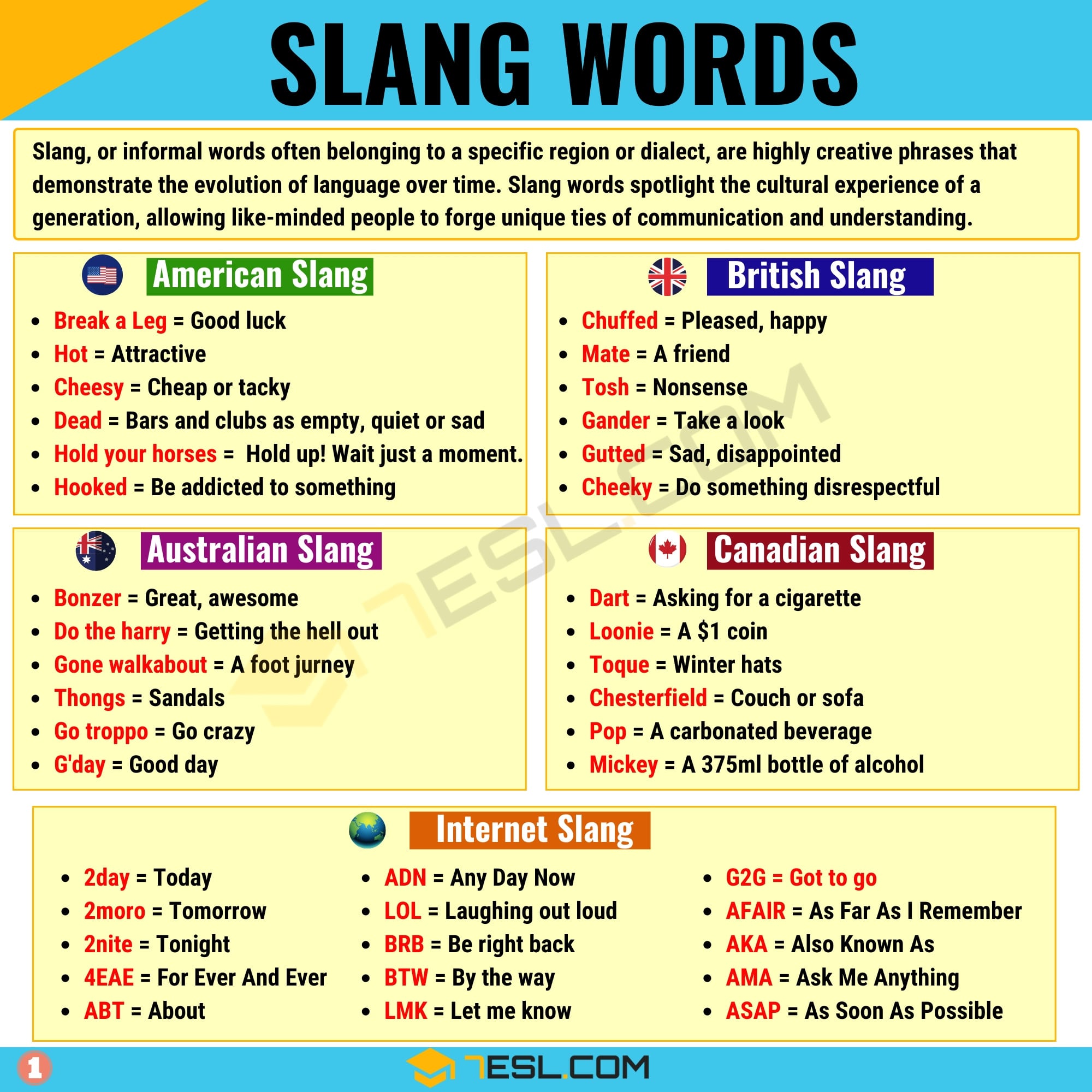
While that may be true, there’s something to be said for all the “inappropriate” or “incorrect” usages of language. Slang, or informal words often belonging to a specific region or dialect, are highly creative phrases that demonstrate the evolution of language over time. Slang words spotlight the cultural experience of a generation, allowing like-minded people to forge unique ties of communication and understanding. Because slang terms are often understood by select populations in specific areas of the world (especially sub groups within majority cultures), they showcase a sense of belonging, and simultaneously act as a means of maintaining identity.
Slang words have also been coined by people responsible for shaping history – authors, poets, artists, musicians, soldiers and protesters – who continue to impact us today. Art, literature, history, entertainment and advertising are all packed with slang words which add passion, meaning and intensity to our everyday lives.
How to Learn Slang Words
Ads paying for your free English lessons. Prefer a quiet page? Go ad-free
Therefore, while you might focus on learning a new language “properly” (as you should), truly understanding a language means mastering every aspect of it. This includes slang words, idioms and regional dialects. So, how do you learn slang? Slang is typically learned outside of the classroom for a reason. It’s learned through cultural immersion, perhaps by visiting a foreign country and spending time in local bars and restaurants. You can also hear foreign languages in real-world contexts by watching subtitled TV shows and movies.
If you’re a native English speaker, try listening to a favorite sitcom (like Friends or Seinfeld) in French or Spanish while reading English subtitles. Who knows? You might gain a richer appreciation of Joey’s speech mannerisms or Kramer’s ridiculous responses. Another way to learn slang words is to read them online, as the internet is full of slang. And for the truly ambitious, there are plenty of online resources, like classes and books, that you can thoroughly immerse yourself in in order to understand the ins and outs of language.
Types of Slang Words
With 1.5 billion speakers worldwide, English is the most widely spoken language. And in our current Technology Age, English has assumed the dominant language of global communication on the internet. But that doesn’t mean English sounds the same wherever it’s spoken. Some American slang terms and words can seem like an alien language to Brits and Australians – or even to other Americans, depending on your regional dialect.
In addition to internet slang, there are several types of slang words. Below, we’ll take you through just a few of the most popular ones that you’re likely to hear in some of the most widely-spoken languages.
American Slang
Even if you’re not a native English speaker, use these sayings and you’ll soon be sounding the part!
- Screw up: To mess up or make a mistake.
- My bad: My mistake.
- Kudos: Kudos means “congrats” or “great work”! It can be used in all situations.
- Cheesy: Nope, it doesn’t actually have anything to do with cheese. Something that’s cheesy is cheap or tacky, such as a cheesy pick-up line or a cheesy movie.
- Binge: The dictionary defines “binge” as an “excessive indulgence”. Given the rise of “Netflix and Chill” culture, it’s common for Americans to admit to “binge-watching” a favorite TV show.
- Shoot the sh*t: An alternate expression to making small talk. Asking someone about the weather or their weekend is an example of shooting the sh*t.
- Twenty four seven (24/7): Refers to something that’s non-stop or around the clock – for example, “that grocery store is open 24/7”.
- It’s not rocket science: This saying explains something by hyperbolically stating what it is not. If it’s not rocket science, then it must be easy.
- That hits the spot: Expresses that something (usually food or drink) was exactly what you needed.
- Hold your horses: Wait just a second!
British Slang
It might not be the Queen’s English, but these phrases are guaranteed to familiarize you with how the Brits talk. Here are examples of British slang words you should learn:
- Chuffed: When someone is chuffed, they are pleased or happy about something.
- Knackered: Deriving originally from “knacker”, which refers to a person who slaughters old worn-out horses, “knackered” expresses exhaustion.
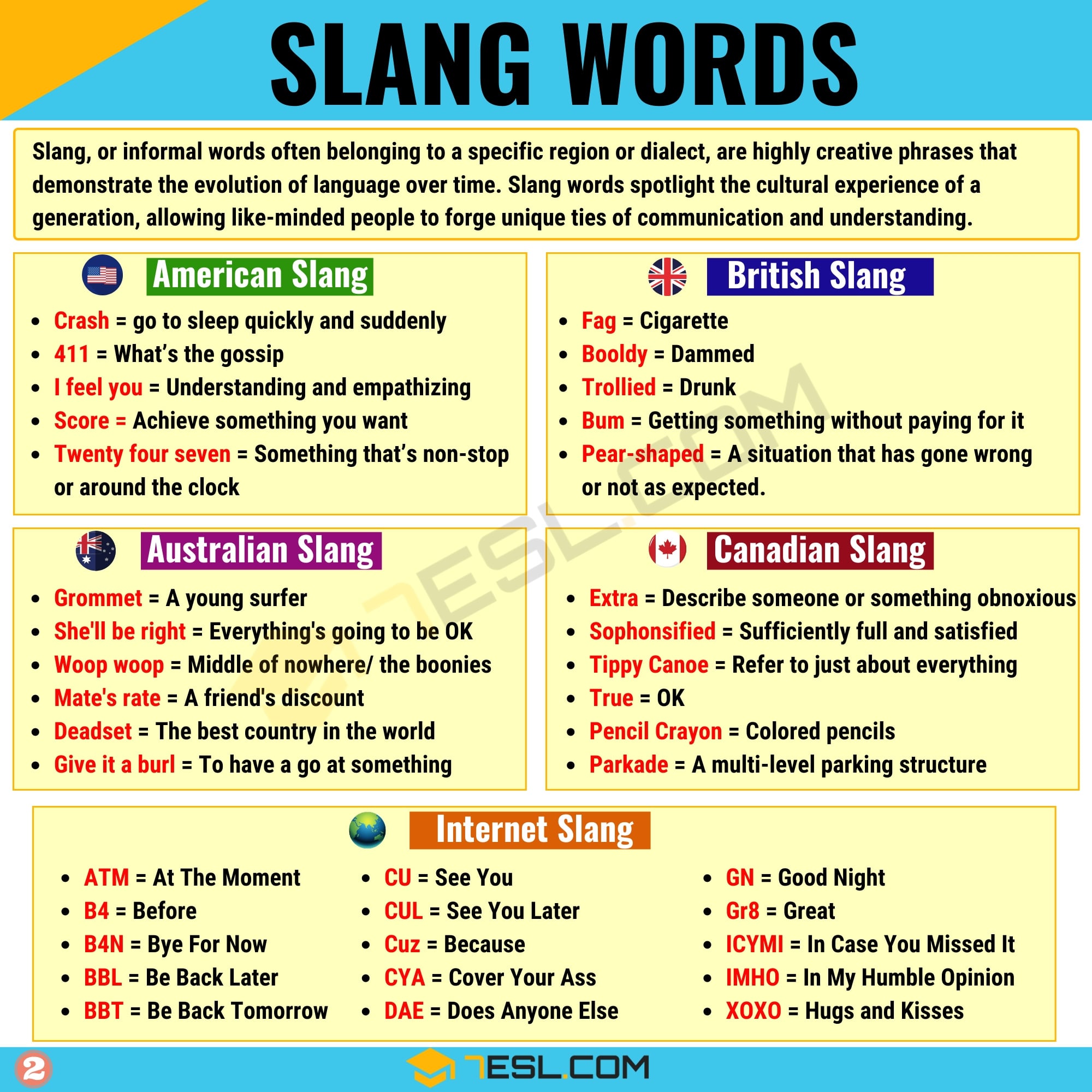
- Fag: This derogatory American expression means something entirely different in the UK. A fag is simply a cigarette.
- Cuppa: The Brits love their tea, so this has naturally made its way into slang. “Cuppa” comes from “cup of” and implies a cup of tea … for a reason.
- Mate: A friend. This word can also be used to address strangers in informal situations.
- Nowt: This is a word which is used to say ‘nothing.’ It might be heard in a sentence such as ‘I really must go shopping, I’ve got nowt at all in the fridge.’
- Bloke: A bloke is simply used to talk about a man. You might hear someone say ‘I like Martin, he is a decent bloke.’
- Tosh: When you say that something is tosh, you mean that this is a bunch of nonsense. The word “baloney” can also be used in the same context.
- Gander: This word is usually used as part of the phrase “take a gander” which means “take a look”. For example, if you’re struggling with your Math homework, you can ask one of your friends to take a gander at the equation and help you with it.
- Gutted: This is a very popular British slang word. When someone’s feeling gutted, they’re very sad, disappointed, and devastated.
Australian Slang
Master the following Australian slang words, and you’ll be fair dinkum.
- Arvo, smoko, bottle-o, defo: Australian slang is characterized by its clipped words and phrases, especially those ending with soft vowels like “ie”, “a” or “o”. A smoke break becomes “smoko”, a liquor store is a “bottle-o” and afternoon turns into “arvo”.
- Bonzer: This Australian equivalent of the American “awesome” can be used as an adjective (“bonzer” mates), noun (that game was a real “bonzer”), adverb (the drink went down “bonzer”) and exclamation (“bonzer”!).
- She’ll be right: No worries – everything’s going to be OK!
- Grommet: A young surfer
- Have a roo loose in the top paddock: Just like the American phrase, “a few fries short of a happy meal”, this idiomatic Australian saying describes an intellectually impaired person. Naturally – the more roos loose, the more moronic the person.
- What’s the John Dory?: This phrase is asked when someone wants to know the gossip, or what’s going on.
- Gone walkabout: This phrase derives from indigenous culture, as “walkabout” was a foot journey taken by Aborigines into the bush in order to live according to traditional indigenous practices.
- Stubbie holder: If you go to a game or the beach, you’ll likely bring along your stubbie holder. Another word for a koozie, a stubbie holder is so-named because it holds your stubbie (beer).
- G’day: What list would be complete without the most classic of all Aussie slang? “G’day” combines the word “good” and “day” into one.
- Thongs: It’s not what you’re thinking, OK? Thongs are sandals.
Canadian Slang
These popular Canadian slang words will help you fit in in the Great White North.
- Skookum: This British Columbian term is used by Canadians to mean exceptional or awesome. Someone who calls you “skookum” isn’t comparing you to a skunk. In fact, the opposite is true – it’s a real compliment!
- Tippy Canoe: Canadians say “tippy canoe” in reference to just about everything that looks to be in danger of falling over. Careful over there; that chair looks like a real tippy canoe.
- Dart: Don’t be confused if someone asks you if you’ve got a dart handy. They’re just asking for a cigarette.
- Chesterfield: Nope, you’re not in a field, and this word has nothing to do with chestnuts. “Chesterfield” is typically used by older generations to mean to a couch or sofa. Hey Jimmy, why don’t you relax on the chesterfield and put your feet up?
- The Dep: “Dep” is an abbreviation of the French “depanneur”, meaning a repairman. In modern day, this word refers to a local corner store – so the linguistic thinking here is that a 7-11 can fix just about anything that might be wrong with you.
- Loonie: This is a word used to describe a $1 coin.
- Toque: Another piece of Canadian slang, but you will not hear a little Canada, symptoms of warm it did winter hats.
- Pop: In Canada, a POP is a carbonated beverage, such as a Coca-Cola or a Sprite.
- Mickey: In Canada, the locals use the word Mickey to describe a 375ml bottle of alcohol.
- Extra: It’s used to describe someone or something obnoxious. So you might overhear someone representing one of their friend’s dresses, “it is a little extra.”
Internet Slang
Places like social media forums and online messaging might seem like a foreign world. But with these helpful abbreviations, they won’t feel quite so scary. Here are some example of internet slang words:
- LOL – Laughing out loud
- BRB – Be right back
- BTW – By the way
- LMK – Let me know
- G2G – Got to go
- FOMO – Fear Of Missing Out
- FTFY – Fixed That For You
- FTL – For The Loss
- FTW – For The Win
- FWB – Friends With Benefits
- FWIW – For What It’s Worth
- FYE – For Your Entertainment
- FYEO – For Your Eyes Only
- FYI – For Your Information
- GA – Go Ahead
A to Z Slang Words
In this section, we will go through a list of slang words from A to Z, explaining their meanings and providing examples. The list is split into four sub-sections, each covering a different range of letters to make it easier to navigate.
A-F
- A
- ASAP: As soon as possible
- AF: As [expletive, use with caution]
- B
- BFF: Best friend forever
- BTW: By the way
- C
- Chill: Relax or calm down
- Crash: To go to someone’s place, usually for a short time
- D
- Dank: High quality, excellent
- DIY: Do it yourself
- E
- Epic: Extraordinary, great, or impressive
- Extra: Over the top, excessive
- F
- FOMO: Fear of missing out
- FTW: For the win, expressing enthusiasm or support
G-L
- G
- Ghosting: Ignoring someone suddenly and without explanation
- Gucci: Good or cool
- H
- Hangry: Hungry and angry
- Hype: To build excitement or enthusiasm, often exaggerated
- I
- ICYMI: In case you missed it
- IRL: In real life
- J
- JK: Just kidding
- JOMO: Joy of missing out
- K
- Kudos: Praise, approval, or respect for an achievement
- KVLT: Extreme, underground or uncommercialized
- L
- Lit: Exciting, fun or energetic
- LMAO: Laughing my [expletive, use with caution] off
M-R
- M
- Meme: A humorous image or idea that is shared on the internet
- MVP: Most valuable player or person
- N
- NSFW: Not safe for work, explicit content
- NBD: No big deal
- O
- OMG: Oh my god
- On Fleek: Perfect, on point
- P
- Petty: Making a big deal out of something insignificant
- Pog: Play of the game, great or impressive achievement
- Q
- QT: Cutie, an attractive person
- QOTD: Quote of the day
- R
- ROFL: Rolling on the floor laughing
- RT: Retweet, to share a post on Twitter
S-Z
- S
- Savage: Ruthless, cool or impressive in a harsh or tough way
- Simmer down: Calm down or relax
- T
- TBH: To be honest
- TLDR: Too long, didn’t read
- U
- UFO: Unidentified flying object
- URL: Uniform Resource Locator, a web address
- V
- Vibe: Atmosphere or mood
- VIP: Very important person
- W
- Woke: Socially aware, informed on current issues
- WTF: What the [expletive, use with caution]
- X
- XOXO: Hugs and kisses
- XTreme: Extreme, intense, or over-the-top
- Y
- YAAAS: Enthusiastic agreement, “yes”
- YOLO: You only live once
- Z
- Zoned out: Lost in thought, not paying attention
- ZZZ: Sleep or tiredness
Popular Slang Words and Their Meanings
Slang is an informal way of communicating that constantly evolves and differs across regions and generations. In this section, we will discuss popular slang words and their meanings, covering some common terms like “k”, “lit”, “bae”, “chicken”, “ball”, “airhead”, and “jam”.
- K (okay, alright): A shorthand way of saying “okay” or “alright”, often used in text messages or online conversations to express agreement or understanding. For example, “I’ll meet you at the park. K?”
- Lit (exciting, lively): This term is used to describe a situation or event that is very exciting, lively, or fun. It can also be used to describe someone who is very energetic or enthusiastic. For example, “That party was so lit last night!” or “She’s always so lit when she’s dancing.”
- Bae (before anyone else; significant other): Bae is a term of endearment, meaning “before anyone else.” It’s commonly used between romantic partners but can also be used between close friends. For example, “I’m spending the weekend with my bae.”
- Chicken (coward, scared): In this context, “chicken” refers to someone who is cowardly or scared. It’s often used as a taunt or challenge, urging someone to face their fears. For instance, “Don’t be a chicken, just ask her out!”
- Ball (have a good time, enjoy oneself): To “ball” means to have a good time or enjoy oneself, generally in the context of attending a party or social event. For example, “We’re going to ball at the concert tonight.”
- Airhead (unintelligent, not aware): An airhead is someone who is perceived as unintelligent or not aware of their surroundings. It’s usually used as a lighthearted insult or joke. For instance, “She’s such an airhead; she put her shoes on the wrong feet!”
- Jam (favorite song, musical enjoyment): A “jam” is a favorite song or piece of music that someone loves and enjoys. It’s used to express enthusiasm for a particular song or artist. For example, “This is my jam! I can’t help but dance when it comes on.”
These slang words are just a few examples of how language can adapt and change to create a more casual and informal way of communicating.
English Slang Words Origins
Slang words are an integral part of the ever-evolving English language. They often come from diverse backgrounds, cultures, and historical periods. This section explores the origins of some popular English slang words.
English slang words have various sources. Some slang words stem from popular culture, such as movies, music, and social media platforms. For instance, words like “cool” and “lame” came into prominence during the 20th century, influenced by youth culture and mass media.
Another origin of slang is from regional dialects and accents. For example, the word “nowt,” meaning nothing, comes from Northern England. Regional slang can spread beyond its initial geographic area, becoming widely recognized and understood across the English-speaking world.
In some cases, English slang words have roots in other languages, reflecting the influence of different cultural groups in English-speaking countries. For instance, “schmooze” comes from the Yiddish word “shmuos,” meaning friendly conversation. Borrowed words like this one are often adapted and transformed to fit the English language and its unique pronunciation patterns.
Slang words can also arise from wordplay and linguistic creativity. Some slang terms are created by shortening or abbreviating existing words, such as “lit” (short for “legitimate”) or “fam” (short for “family”). Others involve combining or altering words to create new phrases, like “no cap,” which is thought to have predated social media and has been in use for several decades.
To summarize the various origins of English slang words:
- Popular culture (movies, music, social media)
- Regional dialects and accents
- Borrowed from other languages
- Wordplay and linguistic creativity
Understanding the origins of slang words provides a glimpse into the dynamic nature of the English language and its capacity to embrace influences from various sources. Slang words are more than just informal terms; they carry the cultural history and evolution of the language in their meanings and use cases.
American Slang Words
In the diverse landscape of American slang, you will find an abundance of interesting and colorful expressions that vary from region to region. These slang words can give you a glimpse into American culture and the way people communicate informally. Here, we have compiled a list of some common American slang words from A to Z. While this is by no means an exhaustive list, it should provide you with a solid starting point for understanding American slang.
- Ace: Great, excellent. Often used for achievements or successes.
- Bucks: Slang term for US dollars, the currency of the United States.
- Chill: Relaxed or calm, sometimes used as an adjective to describe a person or situation.
- Dough: Another slang term for money, often used when talking about a large amount.
- Epic: A term used to describe something as impressive or extraordinary, often used in a positive way.
American slang is influenced by various factors such as the geographic region, pop culture, and local colloquialisms. For example:
- Greenbacks: Slang term for paper money in the United States, originally derived from the green color of early American currency during the 1800s.
- Hyped: Excited or enthusiastic, often related to an upcoming event or action.
- Iced: Used in reference to someone being killed, often in the context of crime or gang-related events.
- Jacked: Stolen or taken by force. It can also refer to a person who is physically strong or muscular.
- Kicks: Slang for shoes or sneakers, often used in the context of fashionable footwear.
Some slang words are specific to particular subcultures or occupations, such as American football, where terms like ‘quarterback’ are widely used:
- Quarterback (QB): The primary leader and decision-maker on an American football team who calls the plays, throws the ball or hands it off to initiate the offense.
- Longshot: A term that refers to something or someone with a low probability of success, often referring to bets or other competitive situations.
- MVP: An abbreviation for “Most Valuable Player,” often used to describe the best or most essential player on a team.
- Nosebleed: In the context of sports or entertainment, referring to very high, distant seating areas in a stadium or arena where the view may be obstructed.
Lastly, here are a few more American slang words to round out our A-Z list:
- Outta: A colloquial contraction of “out of,” often used in informal speech.
- Pumped: Excited or full of energy, typically about something that is about to happen.
- Qapla’: Although not strictly American, this is a phrase from the fictional Klingon language in Star Trek, meaning “success” or “victory.”
- Rap: Informal speech or conversation, also the name of a popular music genre.
- Stoked: Excited, enthusiastic, similar to ‘amped’ or ‘hyped.’
- Threads: Slang for clothing or garments.
- Up for grabs: Available or open to anyone, usually referring to a contest or competition.
- Vibes: Short for vibrations, it refers to the atmosphere or feelings around a specific event or location.
- Wired: Extremely alert or energetic, often due to consuming caffeine or other stimulants.
- X-factor: A quality or characteristic that cannot be easily described or defined, but makes someone or something stand out or excel.
- Yolo: An acronym for “You Only Live Once,” used to justify taking risks or seizing opportunities.
- Zoned out: Inattentive, daydreaming or not paying attention, often due to tiredness or boredom.