
A1 Movers Practice Tests
10 full-length practice tests in the official A1 Movers format. Each test has three papers — Listening, Reading & Writing and Speaking — with audio and instant feedback.
A1 Movers Practice Test 1 with Answers
A free, interactive A1 Movers practice test with answers, about 62 minutes.
TopicsThe homeAnimalsDaily life
This A1 Movers Practice Test 1 has 3 papers — Listening, Reading & Writing and Speaking. Choose a paper below to start; your browser will load the interactive version automatically.
Listening
Part 1 — Listen and draw lines
Listen and draw a line from each name to the right person. There is one example.
- Names: Tom, Pat, Sue, Anna, Ben, Kim. Listen and draw a line from each name to the right person.
Part 2 — Listen and write
Listen and write a word or a number. There is one example.
- Listen and write: Sister's name:
- Listen and write: Number of fish:
- Listen and write: Parrot's name:
- Listen and write: Party starts at:
- Listen and write: Favourite lesson:
Part 3 — Listen and match
What did the children get for their birthdays? Listen and write a letter in each box. There is one example.
Part 4 — Listen and tick
Listen and tick the correct picture. There is one example.
Part 5 — Listen and colour and write
Listen and colour the objects in the garden. Then write one word.
- Listen and colour: the ball, the fish, the tree, the kite, the flower.
Reading & Writing
Part 1 — Read and write
Look at the pictures and read the sentences. Write the correct word. There is one example.
- You sleep in this at night. It is in your bedroom.
- This small animal has long ears and can hop. It likes eating carrots.
- You hold this in your hand and drink hot milk or tea from it.
- This is a round fruit. It is often red or green and it is sweet.
- This animal can fly and sing. It often lives in a tree.
Part 2 — Complete the conversation
Read the text and choose the best answer. There is one example.
Part 3 — Read and choose
Read the text about Tom's day. Choose the right word from the box and write it. Then choose the best title.
Part 4 — Complete the sentences
Read the text about rabbits and choose the right word for each gap. There is one example.
- Lots of children ___ a rabbit as a pet. (has / have / having)
- A rabbit's ears are much ___ than its tail. (long / longer / longest)
- Rabbits love eating ___ , like carrots. (vegetable / vegetables / fruit)
- Rabbits ___ jump very well. (is / can / does)
- Pet rabbits must ___ some water every day. (drink / drinks / drinking)
Part 5 — Read the story and write
Read the story. Write some words to complete the sentences. You can use 1, 2 or 3 words.
Last Sunday, Ben and his little sister Kate took their dog, Jasper, to the park near their house.
It was a very hot day, so the children put on their sun hats. Jasper ran in front of them.
Ben threw a red ball up into the sky, and Jasper jumped and caught it in his mouth.
After the game, they were all thirsty. Kate put some water in a bowl, and Jasper drank it all.
Then some big grey clouds came and it started to rain, so the three of them ran home for lunch.
- Ben went to the park with his sister, Kate, and their ___ .
- It was hot, so the children put on their ___ .
- Ben threw a ___ up into the sky.
- Jasper caught the ball in his ___ .
- Kate put some ___ in a bowl for Jasper.
- It started to rain when some big grey ___ came.
- The children and Jasper ran home to have ___ .
Part 6 — Look and write
Look at the picture. Answer the questions and write sentences about the picture.
Speaking
Part 1 — Find the differences
Look at the two pictures. They look the same, but some things are different. The examiner tells you one difference. Then you tell the examiner three more.
- Here are two pictures. They look the same, but some things are different. In my picture, the dog is brown, but in your picture, the dog is grey. Now you tell me about your picture. Example: (This one is the example. The examiner says it, not you.)
- What's different in your picture? Example: In my picture, the ball is purple. In your picture, it's red.
- Good. And another one? Example: In your picture, there's a yellow kite, but in my picture, there's a pink balloon.
- And one more difference, please. Example: In your picture, the dog is next to the tree, but in my picture, it's next to the flower.
Part 2 — Tell the story
These pictures show a story. It is called 'Jasper in the park'. Look at the pictures first. Then tell the story.
- These pictures show a story. It's called 'Jasper in the park'. Look at the pictures first. Jasper is in the park with his red ball. He's very happy. Now you tell the story. Example: Picture two: Jasper kicks the ball and it goes up into the sky. Jasper runs after it. Picture three: A girl comes to the park. She sees the red ball and wants to play with Jasper. Picture four: The girl throws the ball and Jasper catches it. Now they are playing together and Jasper is very happy.
Part 3 — Which one is different?
Look at the four pictures in each set. One is different. Say which one is different and why.
- Look at these four pictures. Which one is different, and why? Example: The apple is different. A dog, a rabbit and a horse are animals, but an apple is a fruit.
- Now look at these four. Which one is different, and why? Example: The fish is different. A ball, a kite and a doll are toys, but a fish is an animal. It lives in water.
- And here are four more. Which one is different, and why? Example: The tree is different. You can go to places on a bus, in a car and on a train, but a tree is a plant.
Part 4 — About you
Now the examiner asks you some questions about you. Answer in full sentences.
- Have you got any pets at home? Example: Yes, I've got a cat. Her name is Lucky. / No, I haven't, but I'd like a small dog.
- What do you play with your friends after school? Example: We play football in the park, and sometimes we ride our bikes.
- What's in your bedroom? Example: There's a blue bed and a small desk. I do my homework and read comics there.
Ads paying for your free English lessons. Prefer a quiet page? Go ad-free
A1 Movers Practice Test 2 with Answers
PetsFarm animalsWild animals
Listening · Reading & Writing · Speaking · about 62 min
Start Test 2 →A1 Movers Practice Test 3 with Answers
FruitMealsSnacks
Listening · Reading & Writing · Speaking · about 62 min
Start Test 3 →A1 Movers Practice Test 4 with Answers
SportsToysGames
Listening · Reading & Writing · Speaking · about 62 min
Start Test 4 →A1 Movers Practice Test 5 with Answers
The home & furnitureRooms in the houseThings in the house
Listening · Reading & Writing · Speaking · about 62 min
Start Test 5 →A1 Movers Practice Test 6 with Answers
ClothesGetting dressedDaily life
Listening · Reading & Writing · Speaking · about 62 min
Start Test 6 →A1 Movers Practice Test 7 with Answers
TransportTravelJourneys
Listening · Reading & Writing · Speaking · about 62 min
Start Test 7 →A1 Movers Practice Test 8 with Answers
Places in townJobsDaily life
Listening · Reading & Writing · Speaking · about 62 min
Start Test 8 →A1 Movers Practice Test 9 with Answers
The body and the faceFeeling illAt the doctor
Listening · Reading & Writing · Speaking · about 62 min
Start Test 9 →A1 Movers Practice Test 10 with Answers
WeatherThe natural worldThe outdoors
Listening · Reading & Writing · Speaking · about 62 min
Start Test 10 →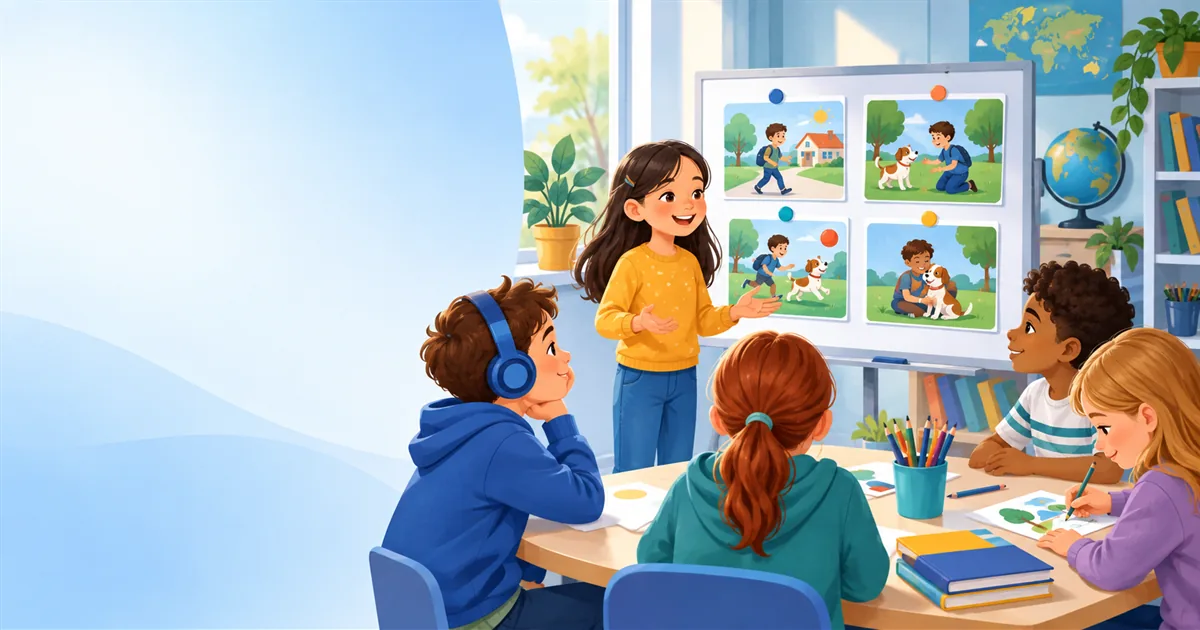
The three Movers papers
A1 Movers is made up of three papers, exactly as in the real exam. You can sit a whole test or practise one paper at a time:
How Movers is scored
Movers has no pass or fail — it is designed to be a positive experience for young learners. Children earn up to five shields on each paper; five shields shows very good understanding. On 7ESL each completed paper also gives XP.
What is A1 Movers?
A1 Movers (also known as Cambridge Movers or YLE Movers) is the second of the three Cambridge English Qualifications for young learners, between Pre A1 Starters and A2 Flyers. It is designed for primary-age children and tests English at CEFR level A1: understanding simple conversations and stories, describing pictures and talking about daily life.
The exam takes about one hour. The standard version is paper-based with a face-to-face Speaking test. There is also A1 Movers Digital, in which the Listening and Reading & Writing papers are taken on a computer or laptop (tablets are not used) and the Speaking test stays face to face. The level and the skills tested are the same in both versions. The task types follow Cambridge’s 2018 revision of the young learners exams, as set out in the 2024 handbook for teachers.
Who takes Movers and why
Movers is taken mainly by children in primary school who have already studied English for a year or two, often after Pre A1 Starters. Teachers use it as a clear target for a school year, and parents use the certificate to follow their child’s progress. It is not used for university entry or visas; it is a motivating step on the way to A2 Flyers and, later, A2 Key for Schools.
Compared with Starters, Movers asks children to write short sentences, follow a simple story told in pictures, and give reasons with words like because.
A1 Movers format at a glance
| Paper | Parts | Questions | Time |
|---|---|---|---|
| Listening | 5 | 25 | about 25 minutes |
| Reading & Writing | 6 | 35 | 30 minutes |
| Speaking | 4 | – | 5–7 minutes |
Each Listening recording is heard twice. The Speaking test is one child with one examiner: the child finds differences between two pictures, tells a picture story, picks the odd one out and answers questions about themselves.
Results and shields
Nobody passes or fails Movers. Every child gets a certificate that shows up to five shields for each of the three papers, so 15 shields is the top result. Five shields on a paper means the child did very well; one shield means they took the test but still have plenty to learn in that skill. Cambridge explains the link to the CEFR on the back of the certificate and maps results to the Cambridge English Scale.
Digital results normally come 5 to 10 days after the exam. Paper-based results take a few weeks. The certificate never expires. Centres set their own dates and fees, so check the fee in your country.
How to prepare with 7ESL
Our Movers practice tests follow the public Movers format, with a new theme in every test. Try a full test or focus on one skill:
- Listening practice – natural recordings at a steady pace, marked instantly;
- Reading & Writing practice – definitions, dialogues and stories with automatic marking, plus a model answer for the sentence-writing task;
- Speaking practice – the examiner’s turns are spoken aloud, then a quiet gap gives your child time to answer before the model answer appears.
Children collect shields and XP as they go, which makes regular practice feel like a game.
Tips for Movers test day
In Reading & Writing, remind your child to copy words carefully, because spelling counts in many parts. In the picture story, encourage them to say what is happening in each picture, not just name objects. If they do not understand a question in Speaking, it is fine to say “Can you say that again, please?” – examiners expect it. Plenty of sleep and a relaxed morning help more than last-minute study.
Sources checked for this page
- cambridgeenglish.org/Images/357180-starters-movers-and-flyers-handbook-for-teachers-2024.pdf
- cambridgeenglish.org/exams-and-tests/qualifications/young-learners/paper/
- cambridgeenglish.org/exams-and-tests/qualifications/young-learners/digital/
- support.cambridgeenglish.org/hc/en-gb/articles/18987669537426-Digital-young-learners-FAQs
- cambridgeenglish.org/Images/467357-a2-flyers-faqs.pdf
- cambridgeenglish.org/exams-and-tests/qualifications/results/
- cambridgeenglish.org/Images/506166-starters-movers-flyers-word-list-2025.pdf
Study the matching course
Want to master the English behind the exam? Our A1 English course teaches the grammar, vocabulary and skills at A1 level — with structured lessons, worksheets and videos. It is the ideal companion to these Movers practice tests: learn on the course, then check your progress here.
A1 Movers — frequently asked questions
What is in the Cambridge A1 Movers exam?
A1 Movers (CEFR A1) has three papers: Listening, Reading & Writing and Speaking.
How many Movers practice tests are there?
There are 10 free online Movers practice tests on 7ESL, each with all three papers and a different set of topics.
Are the Movers practice tests free?
Yes. Every Movers practice test on 7ESL is free and needs no sign-up. Log in to save your XP and progress.
How is Movers scored?
Movers has no pass or fail — it is designed to be a positive experience for young learners. Children earn up to five shields on each paper; five shields shows very good understanding. On 7ESL each completed paper also gives XP.
Are these official Cambridge tests?
No. These are original 7ESL practice materials that follow the public Movers format. 7ESL is not affiliated with Cambridge Assessment English.
7ESL practice material written in the official Cambridge English exam format. 7ESL is not affiliated with, or endorsed by, Cambridge Assessment English. “Cambridge English”, “Starters”, “Movers”, “Flyers”, “A2 Key”, “B1 Preliminary”, “B2 First”, “C1 Advanced”, “C2 Proficiency” and related names are trademarks of their respective owners.