On this page (5)
You might be thinking that you introduce yourself to people all the time, so surely you don’t need a guide about it. However, there are ways that you can give a self-introduction to send across the right sort of message.
Shuffling into a room and murmuring your name just loud enough to be audible is going to say something quite different than if you strode in with your hand outstretched and your shoulders back. Yes, body language plays a big part in introducing yourself too of course, but language itself is important in conveying the right sort of message to your audience too. First, we’ll take a look at what self-introduction is all about, before giving some tips that’ll help you introduce yourself more effectively.
What is Self-Introduction?

What do you say when you meet someone new? Introduce yourself of course!
Self-introduction is simply the act of introducing yourself to someone else. You might just be introducing yourself to a new person you have never met before, or you might be introducing yourself to hundreds of people in a conference room. Thankfully, both situations actually require the same sort of language and body language to introduce yourself in a way that is both confident, and clear. The two things you should definitely aim to be when introducing yourself to others.
Introducing yourself is much more than saying your name. You need to tell some more information about yourself in English. Introducing yourself to strangers can be tricky because what you say depends on the context, situation (in a job interview, in an email, or give self-introduction in an English class).
In this lesson, you will learn how to confidently introduce yourself in English.
How to Introduce Yourself
General Tips
The tips listed here will apply to almost every situation where you need to introduce yourself. We’ll get more specific later, but for now, let’s focus on the things you can do every time you need to introduce yourself to somebody new:
- State who you are clearly. Try not to mumble or else the person you’re introducing yourself to might have to ask again… and again… and again… until they simply smile and nod without ever knowing what your name is.
- Be friendly. Even in formal situations, you can be friendly. Saying something like “Hi there, I’m…” with a smile says a lot about you. You seem confident and easy to talk to. If you were in a very formal setting you might say “Hello, I am…” the point is you should introduce yourself in a way that is approachable. Very formal settings might require you to use ‘proper’ English (no contraction’s etc.) but in most other areas shortening words is fine.
- Know your audience. It doesn’t matter if you’re speaking to one person or a thousand, knowing your audience is key. Obviously, if you’re introducing yourself you don’t know the person, but from context you should have an idea about how they are going to be. Meeting the in-laws for the first time probably isn’t the best time to tell a joke as you introduce yourself, but meeting a friend of a friend at the bar might be.
- If you are sitting when you first meet somebody you are going to introduce yourself to, then it’s always best to stand if you are able. It’s often seen as the polite thing to do, so it’s a way that you can use body language to impress the person you are introducing yourself to.
Tips For The Student In Class
Introducing yourself to a class full of people is universally acknowledged as being people’s worst nightmare. That being said, you can make things a lot easier for yourself by following these simple tips:
- Be prepared. Know that as you head into a new class, you are going to have to say something about yourself, however much you don’t want to. So, beforehand have a think about what you might say. Is there a reason you’ve taken the class? Is there a hobby you’ve always done that relates to the class?
- Smile. Everybody in the room is dreading introducing themselves too, so smile and create a relaxed atmosphere in yourself, and others will follow suit and smile too.
- Look around the room. Trust us, we know. We want to put our eyes to the floor when introducing ourselves to a class too, but take a deep breath and force your eyes up and look around the room at the faces watching you. By doing this, you’re already making yourself seem more confident. Speak clearly as you state your name, your reason for being there, and your hobbies, and people will already feel like they know you a little better.
How to Introduce Yourself in an Interview
Most of what we have discussed is relevant to introducing yourself in a job interview too, but here are a few extra tips:
- A firm handshake as you enter the room already makes the interviewer think that you are somebody who should be taken seriously. Follow this up with a friendly smile and stating your name and you’ll already be off to a great start.
- Listen! This is so important in interviews. The art of conversation lies predominantly in the gaps between your speeches. Listen with intent so you can answer questions directly. Also, listen so you can adapt. If you think you’re going to be the first person to talk as you enter the interview room, but they start speaking first, then let them. Nobody will think bad of you for not speaking first, you’d certainly look a lot worse if you spoke over them the whole time.
Also, learn the big five personality traits you can use to define who you are in a job interview.

Learn how to answer the most common job interview questions.
Self-Introduction Examples
Introducing Yourself in Class
“Hi, I’m Jane. I’m taking this class because Art History has always been something I’ve been fascinated by, ever since I started taking trips to art galleries as a little girl, and I’m basically just excited to learn a little more.
Simply saying something like this with a smile, will be all the introduction you need.
Self-Introduction in Interview
Something similar to this would work well in answer to that dreaded “Tell me about yourself” question that interviewers love so much.
“Hi, I’m Jane Smith. I’ve always been passionate about Art, and I actually majored in Art History at college last year. Ever since, I’ve been pursuing my dream of becoming an Art handler so I can really work in an area I know a great deal about. So when I saw your job advertisement I couldn’t stop myself from applying.”
Here you’ve introduced yourself clearly, told them exactly what your interests are, and sold yourself as the ideal person for the job.
Networking
“Hi, I’m Jane Smith. I help restore and preserve art. Just last week I actually worked on ‘The White Bridge’ by John Smith and I’ve led various projects throughout the years too. What I’m looking for now is to move into an area of Art where I have opportunities to create art of my own, as well as preserve other people’s. Do you have any thoughts about how I might achieve that?”
In networking it’s important to state what you do, what you’ve done, and what you want to do. Networking is all about introducing who you are in a way that can show you off as a resource to others, but somebody who is open to new connections to help achieve what you want too.
These are very specific examples, but if you include the tips we have pointed out above too, you’ll see that introducing yourself really doesn’t have to be hard. Be confident, speak clearly, and know what you might say, and you’ve already won half the battle.
Introduce Yourself | Samples
Introduce Your Name
Question: What’s your name?
Answers:
- My name is …/ I’m …
- My full/ first/ last name is …
- You can call me …/ They call me …/ Please call me …/ Everyone calls me …
- My nickname is …
Introduce Your Country
Questions:
Where are you from?/ Where do you come from?
Where were you born?
Answers:
- I’m from …/ I hail from …/ I come from …/ My hometown is …/ I’m originally from … (country)
- I’m … (nationality)
- I was born in …
Introduce Your Address
Question: Where do you live?/ What’s your address?
Answers:
- I live in … / My address is … (city)
- I live on … (name) street.
- I live at …
- I spent most of my life in …
- I have lived in … for/ since …
- I grew up in …
Introduce Your Age
Question: How old are you?
Answers:
- I’m … years old.
- I’m …
- I’m over/ almost/ nearly …
- I am around your age.
- I’m in my early twenties/ late thirties.
Introduce Your Family
Questions:
How many people are there in your family?
Who do you live with?/ With whom do you live?
Do you have any siblings?
Answers:
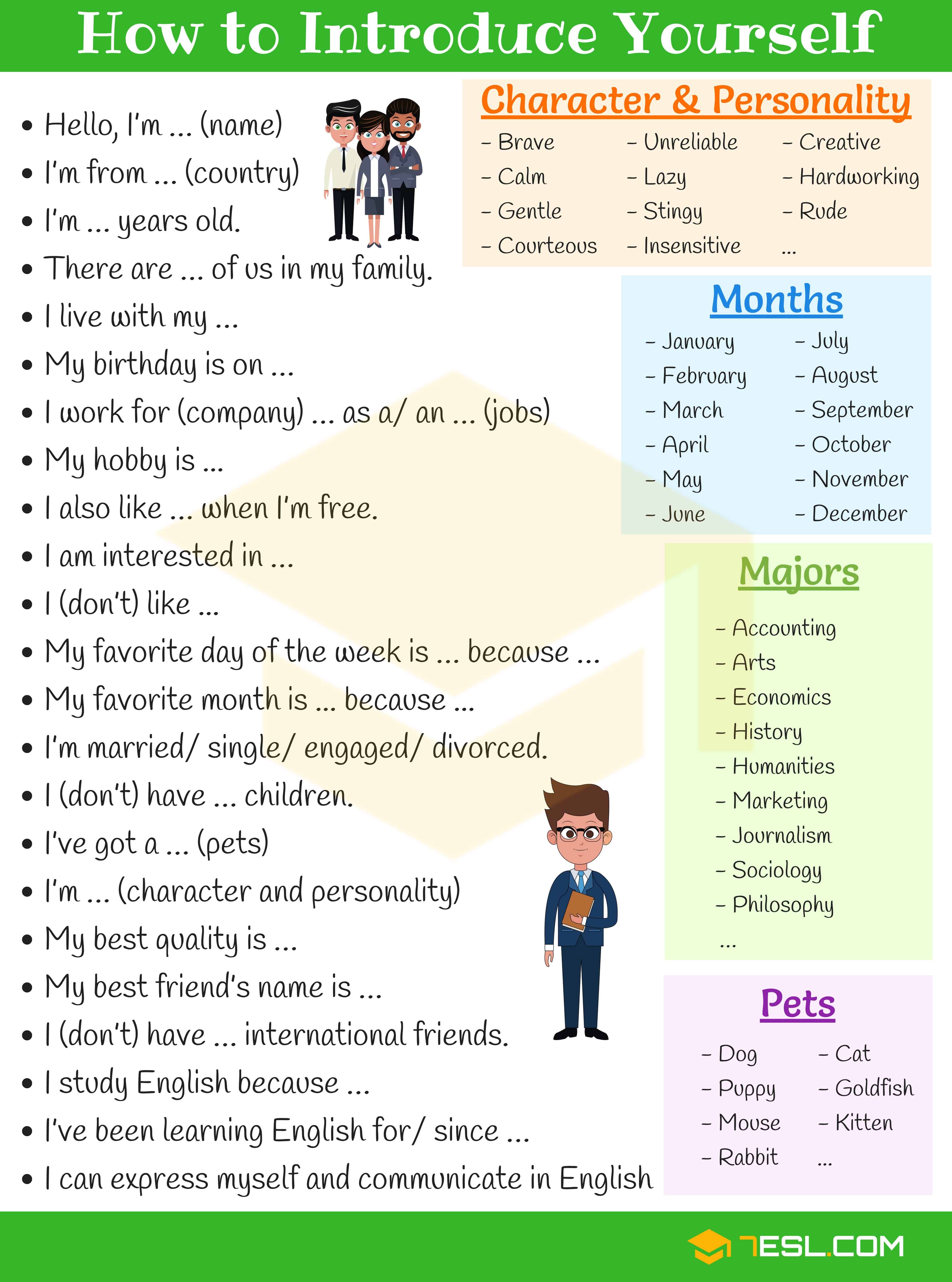
- There are … (number) people in my family. They are …
- There are … (number) of us in my family.
- My family has … (number) people.
- I live with my …
- I am the only child.
- I don’t have any siblings.
- I have … brothers and … sister(s).
Introduce Your Birthday/Phone number
Questions:
What is your date of birth?/ When is your birthday?
What is your phone number?
Answers:
- My birthday is on …
- My phone number is …
Introduce Your Jobs
Questions:
What do you do?/ What do you do for a living?/ What’s your job?/ What sort of work do you do?/ What line of work are you in?
What did you want to be when you grew up?
Answers:
- I am a/ an …
- I work as a/ an …
- I work for (company) … as a/ an …
- I’m unemployed./ I am out of work./ I have been made redundant./ I am between jobs.
- I earn my living as a/ an …
- I am looking for a job. / I am looking for work.
- I’m retired.
- I would like to be a/ an …/ I want to be a/ an …
- I used to work as a/ an … at … (places)
- I just started as … in the … department.
- I work in/at a … (places)
- I have been working in … (city) for … years.
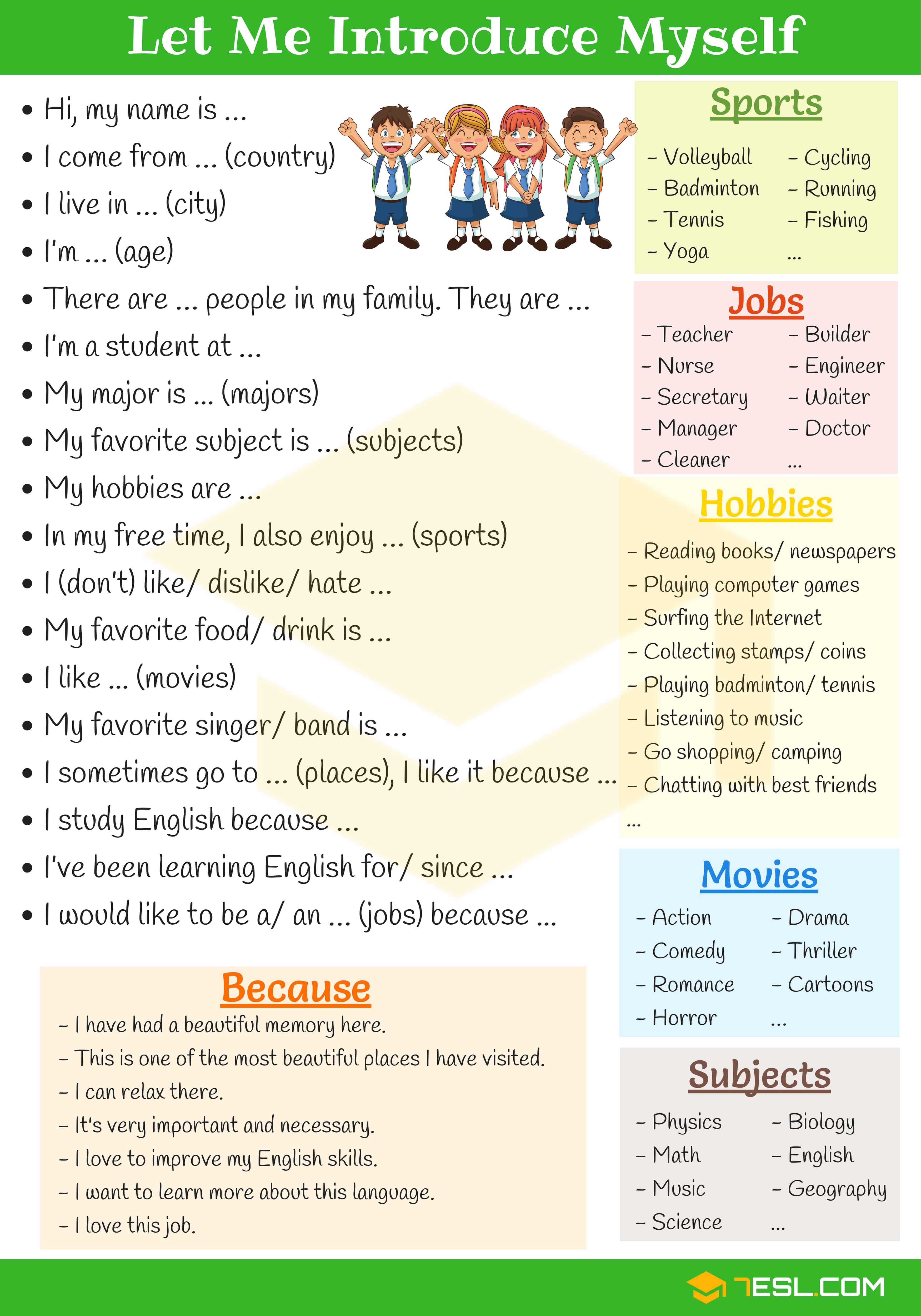
Useful jobs for self-introduction: teacher, nurse, secretary, manager, cleaner, policeman, builder, engineer, businessman, firefighter, postman, doctor, architect, farmer, …
Useful places: bank, factory, supermarket, museum, hospital, shop, gallery, …

Self-Introduction Sample! How to Introduce Yourself in English – Image 2
Introduce Your Hobbies
Questions:
What’s your hobby?/ What do you like?/ What do you like to do?/ What’s your favorite …?
Answers:
- I like/ love/ enjoy/ … (sports/ movies/ …/)
- I am interested in …
- I am good at …
- My hobby is …/ I am interested in …
- My hobbies are …/ My hobby is …
- My favorite sport is …
- My favorite color is …
- I have a passion for …
- My favorite place is …
- I sometimes go to … (places), I like it because …
- I don’t like/ dislike/ hate …
- My favorite food/drink is …
- My favorite singer/ band is …
- My favorite day of the week is … because …
Because: (self-introduction sample)
- There are many things to see and do
- This is one of the most beautiful places I have ever visited.
- I can relax there
- It’s relaxing/ popular/ nice/ …
Hobbies – Free time activities for self-introduction.
- Reading, painting, drawing
- Playing computer games
- Surfing the Internet
- Collecting stamps/ coins/ …
- Going to the cinema
- Playing with friends
- Chatting with best friends
- Going to the park/ beach/ zoo/ museum/ …
- Listening to music
- Shopping, singing, dancing, travelling, camping, hiking, …
Movies: action movies, comedy, romance, horror, documentary, thriller, cartoons, …
Sports: volleyball, badminton, tennis, yoga, cycling, running, fishing, …
Questions: What do you like doing in your free time?/ What do you do in your spare time?
Answers:
- In my free time, I like …
- I like … when I’m free.
- At weekends I sometimes go to … (places)
Introduce Your Education
Questions:
Where do you study?
What do you study? / What is your major?
Answers:
- I’m a student at … (school)
- I study at …/ I am at …/ I go to … (school)
- I study … (majors)
- My major is …
Majors in English: accounting, advertising, arts, biology, economics, history, humanities, marketing, journalism, sociology, philosophy, …
Questions:
Why do you study English?
Do you speak English?
How long have you been learning English?/ How long have you learned English?
Answers:
- I study English because …
- I can speak English very well.
- I’ve been learning English for/ since …
- I can express myself and communicate in English.
Because: (self-introduction sample)
- I like it a lot
- I love it.
- I think it’s important
- I have to
- It’s very important and necessary.
- I want to learn more about this language.
- I love to improve my English skills.
Questions:
Which grade are you in?
Which year are you in?
- I’m in … grade.
- I’m in my first/ second/ third/ final year.
- I am a freshman.
- I graduated from …/ My previous school was …
Question: What’s your favorite subject?
Answers:
- My favorite subject is …
- I am good at … (subjects)
Subjects: Maths, English, Physics, Physical Education, Science, Music, …
Introduce Your Marital Status
Questions: What is your marital status?
Are you married?
Do you have a boyfriend/ girlfriend?
Answers:
- I’m married/ single/ engaged/ divorced.
- I’m not seeing/ dating anyone.
- I’m not ready for a serious relationship.
- I’m going out with a … (someone)
- I’m in a relationship./ I’m in an open relationship.
- It’s complicated.
- I have a boyfriend/ girlfriend/ lover/ …
- I’m in love with … (someone)
- I’m going through a divorce.
- I have a husband/ wife.
- I’m a happily married man/ woman.
- I have a happy/ unhappy marriage.
- My wife/ husband and I, we’re separated.
- I am available.
- I haven’t found what I’m looking for.
- I’m ready for a rebound relationship.
- I’m a widow/ widower.
- I’m still looking for the one.
- I (don’t) have … (number) children.
Introduce Your Personality Traits
- I am a … person/ I’m … (character & personality)
- My best quality is … (character & personality)
Character & Personality for self-introduction: brave, calm, gentle, courteous, creative, hard-working, rude, unfriendly, unreliable, lazy, stingy, insensitive, …
Also learn an extensive list of adjectives to describe yourself.
Others
- I’ve got a … (pet)
- My best friend’s name is …
- I (don’t) have … (number) international friends.
- My dream is …
Pets: dog, puppy, mouse, rabbit, cat, goldfish, …
Self-Introduction Samples
How to Introduce Yourself Casually | Self Introduction
Self-Introduction Samples for Students
Let Me Introduce Myself! Learn how to introduce yourself in an English class.
How to Introduce Yourself | Video Guide
Learn how to give self-introduction in English with video lesson.
 Practise listening