
On this page (3)
Learning the difference between a backslash (\) and a forward slash (/) can boost your writing skills. This article covers when to use each type, the specific punctuation rules, and provides examples with easy-to-understand images. Your writing will be clearer and more accurate with these tips.
Backslash vs. Forward Slash
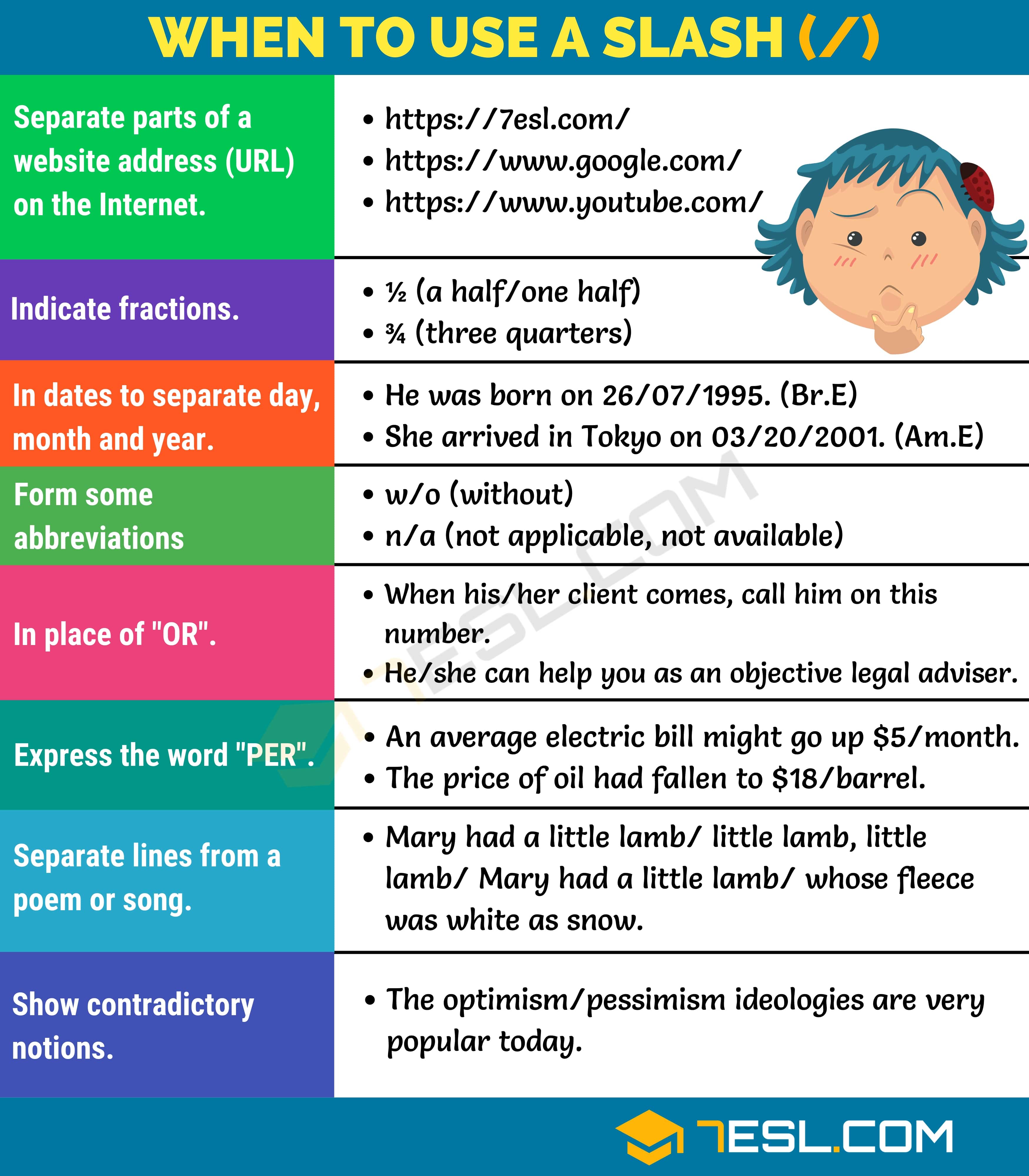
The symbol (\) is called a backslash, while (/) is called a forward slash, which is also known as a virgule, a stroke or even an oblique dash. Thus there are two types of slashes in the English language: a backslash (\) and a forward slash (/).
The backslash (\) is a typographical mark used merely for computer coding and file names. It is not a form of punctuation mark in English. We often use the backslash to separate computer folder names, especially in Windows systems.
The backslash (\) Examples:
- C:\Program Files
- D:\OFFICE\OFFICE 2010
The forward slash (/), often simply referred to as a slash (which is also known as a stroke, a virgule, or even an oblique dash), is a punctuation mark used in English. The slash can be used to separate lines in a song or poem when they are written in a continuous line. This punctuation mark is also used in place of the word or. It can also be used to show two contradictory notions.
When to Use a Slash (/)
1. We use slashes to separate parts of a website address (URL) on the Internet.
Examples:
- https://7esl.com/
- https://www.google.com/
2. We use the slash to form abbreviations.
Examples:
- w/o (without)
- w/ (with)
- b/4 (before)
- b/c (because)
- j/k (just kidding)
- s/t (something)
- n/a (not applicable, not available)
3. We use slashes in dates to separate day, month and year.
Examples:
- He was born on 26/07/1995. (British English)
- She arrived in Tokyo on 03/20/2001. (American English)
4. We use slashes to indicate fractions.
Examples:
- (a half/ one half)
- ¾ (three quarters)
- 1½ (one and a half)
5. We use the slash to indicate the word “OR”
Examples:
- When his/her client comes, call him on this number.
- The director is allowed to designate his/ her successor.
- He/ she can help you as an objective legal adviser.
6. We use the slash to express the word “PER”.
Examples:
- He clocked up 180 km/h on the straight in that car.
- An average electric bill might go up $4/month.
- The price of oil had fallen to $18/barrel.
7. We use the slash to separate lines from a poem or song.
Example:
- Mary had a little lamb/ little lamb, little lamb/ Mary had a little lamb/ whose fleece was white as snow.
8. We use the slash to show contradictory notions.
Example:
- The optimism/pessimism ideologies are very popular today.
 Practise writing


