
On this page (3)
To understand the subjunctive mood within English grammar, we have to understand the different moods that the language affords us. A mood is a verb form that indicates the writer’s attitude towards their words’ contents. In English, these moods are referred to as the subjunctive, the imperative, and the indicative.
The subjunctive mood indicates a hypothetical, a suggestion, a requirement or a desire. The imperative mood is for issuing orders and commands. The indicative mood conveys an opinion or a fact, or we can use it to ask questions. What follows is a definition of the subjunctive mood as well as some helpful examples of what subjunctive sentences look like.
Subjunctive
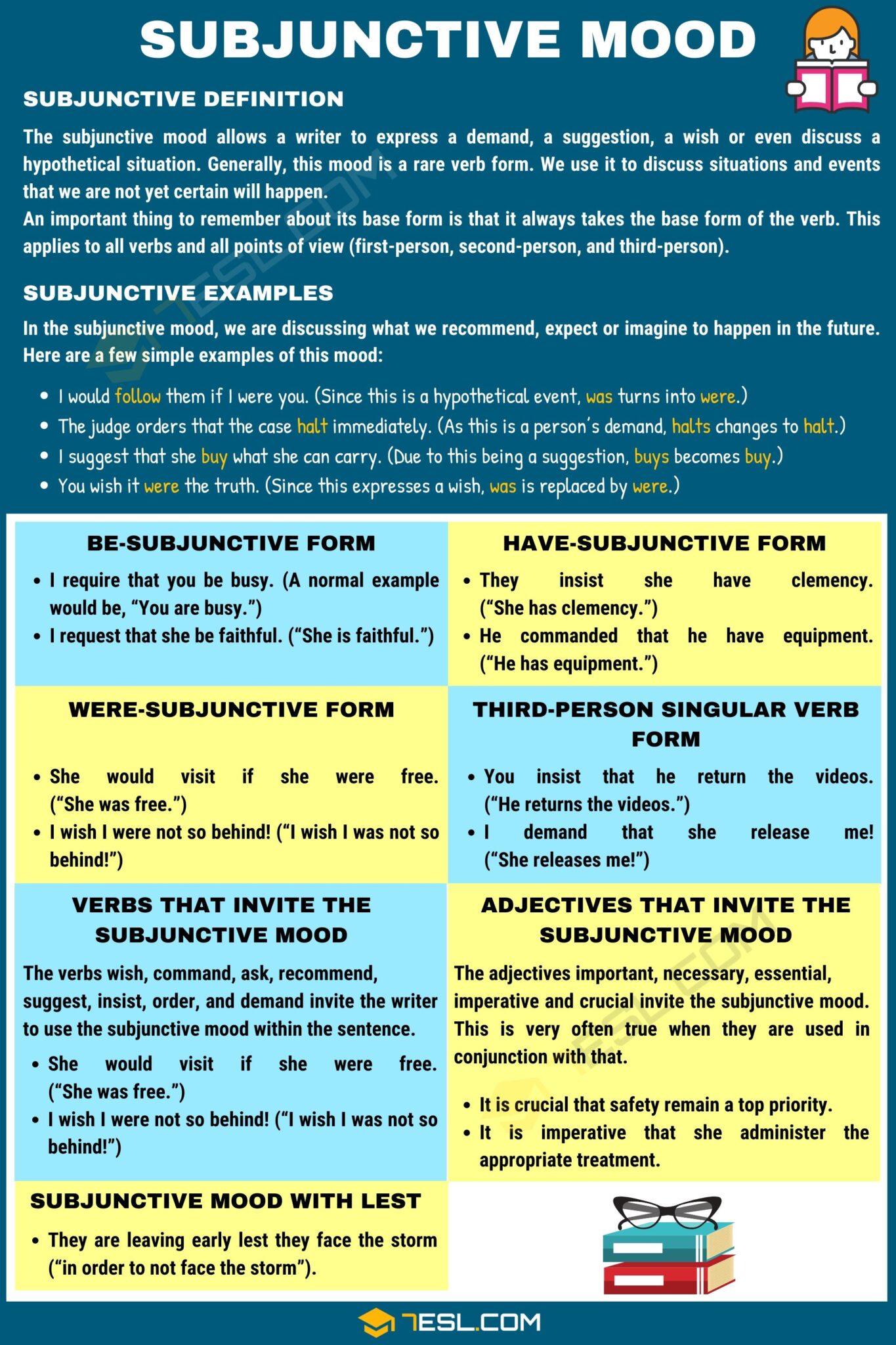
Subjunctive Mood
The subjunctive mood allows a writer to express a demand, a suggestion, a wish or even discuss a hypothetical situation. Generally, this mood is a rare verb form. We use it to discuss situations and events that we are not yet certain will happen.
An important thing to remember about its base form is that it always takes the base form of the verb. This applies to all verbs and all points of view (first-person, second-person, and third-person).
Subjunctive Examples
In the subjunctive mood, we are discussing what we recommend, expect or imagine to happen in the future. Here are a few simple examples of this mood:
- I would follow them if I were you. (Since this is a hypothetical event, was turns into were.)
- The judge orders that the case halt immediately. (As this is a person’s demand, halts changes to halt.)
- I suggest that she buy what she can carry. (Due to this being a suggestion, buys becomes buy.)
- You wish it were the truth. (Since this expresses a wish, was is replaced by were.)
Examples of the Subjunctive Mood
Be-Subjunctive Form
- I require that you be busy. (A normal example would be, “You are busy.”)
- I request that she be faithful. (“She is faithful.”)
Have-Subjunctive Form
- They insist she have clemency. (“She has clemency.”)
- He commanded that he have equipment. (“He has equipment.”)
Were-Subjunctive Form
- She would visit if she were free. (“She was free.”)
- I wish I were not so behind! (“I wish I was not so behind!”)
Third-Person Singular Verb Form
- You insist that he return the videos. (“He returns the videos.”)
- I demand that she release me! (“She releases me!”)
Verbs that Invite the Subjunctive Mood
The verbs wish, command, ask, recommend, suggest, insist, order, and demand invite the writer to use the subjunctive mood within the sentence.
- The ruling ordered that he forfeit all stolen, privately held funds.
- I recommend that we be better stewards of our cities.
Adjectives that Invite the Subjunctive Mood
The adjectives important, necessary, essential, imperative and crucial invite the subjunctive mood. This is very often true when they are used in conjunction with that.
- It is crucial that safety remain a top priority.
- It is imperative that she administer the appropriate treatment.
Subjunctive Mood with Lest
- They are leaving early lest they face the storm (“in order to not face the storm”).
 Practise writing


