On this page (3)
You’ve probably all heard someone reply to the question “What are you doing?” with a standard answer like “Oh, nothing much.” But if you want a more interesting response from your conversation partner, there are lots of fun and creative ways to ask and answer this question. Let’s take a look at some of them!
Other Ways to Ask “What Are You Doing?”
Common Ways to Ask “What Are You Doing?”
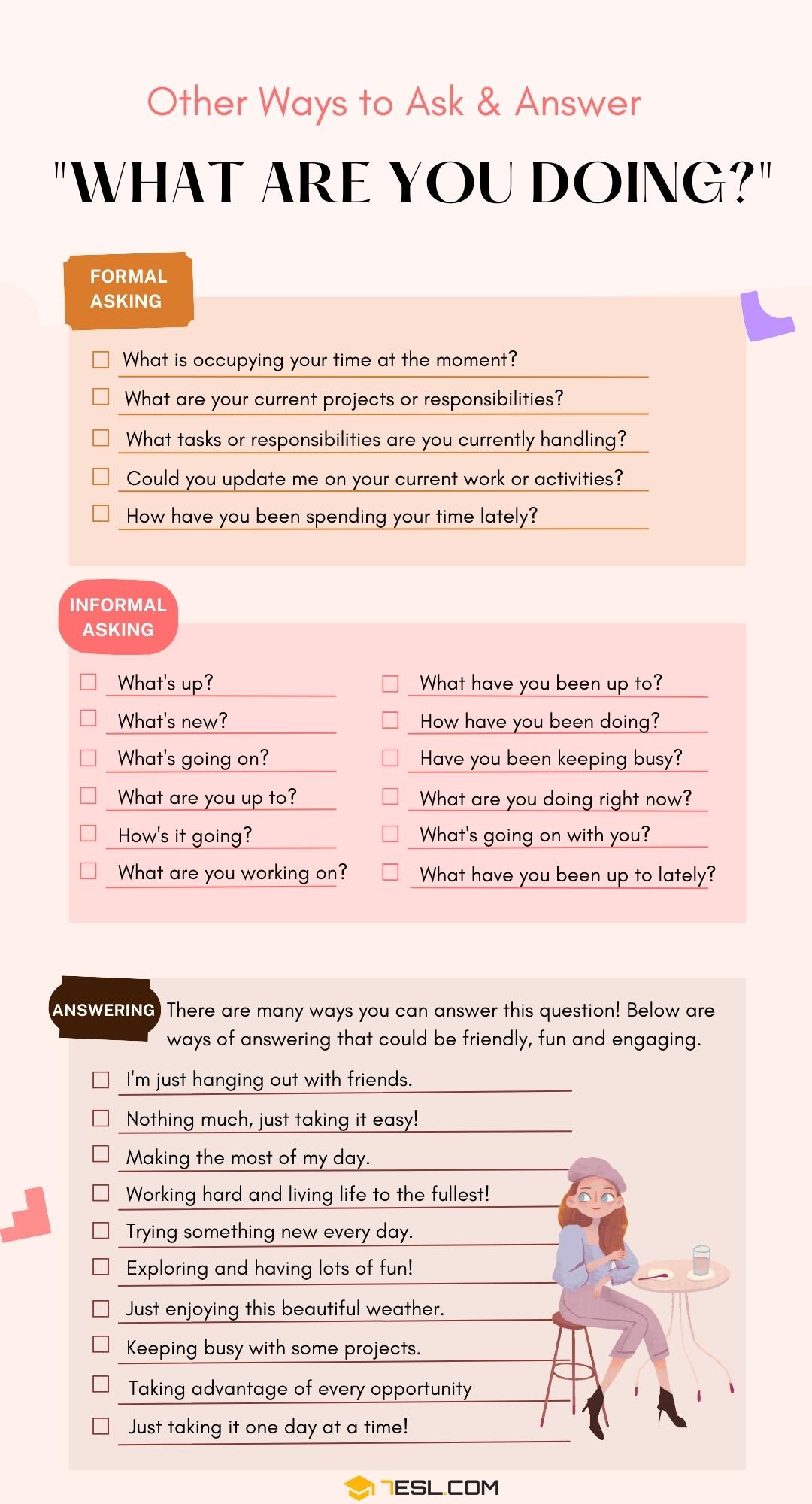
- What are you doing right now?
- What have you been up to?
- What are you working on?
- What’s going on with you?
- What is occupying your time at the moment?
- What are your current projects or responsibilities?
- What tasks or responsibilities are you currently handling?
- Could you update me on your current work or activities?
- How have you been spending your time lately?
Idiomatic Expressions with the Same Meaning
- What’s going on?
- What’s up?
- What’s new?
- What are you up to?
- How’s it going?
- What have you been up to lately?
- How have you been doing?
- Have you been keeping busy?
- What kind of mischief are you getting into these days?
How to Answer the Question “What Are You Doing?”
There are many ways you can answer this question! Below are ways of answering that could be friendly, fun and engaging.
- I’m just hanging out with friends.
- Nothing much, just taking it easy!
- Making the most of my day.
- Working hard and living life to the fullest!
- Trying something new every day.
- Exploring and having lots of fun!
- Just enjoying this beautiful weather.
- Keeping busy with some projects.
- Taking advantage of every opportunity
- Just taking it one day at a time!
Using Other Ways to Ask “What Are You Doing?”
In Formal Situations?
In formal situations, it is generally best to use more formal language when asking about someone’s activities or plans. Here are a few options for asking “What are you doing?” in formal situations:
- What is occupying your time at the moment?
- What are your current projects or responsibilities?
- What tasks or responsibilities are you currently handling?
- Could you update me on your current work or activities?
- How have you been spending your time lately?
These options are more polite and respectful than casual phrases like “What are you up to?” or “What’s going on with you?” which may be too informal or too personal in a formal setting.
In Informal Situations
In informal situations, you can use any of the following phrases to ask someone, “what are you doing?”:
- What’s up?
- What’s new?
- What’s going on?
- What have you been up to?
- What are you up to?
- What are you doing?
Note that some phrases, such as “What’s up?” can be used as casual greetings even when you’re not asking about someone’s activities.
Learn more about different ways to ask and answer “what do you do?“.
Ways to Answer “What Are You Doing?”
When someone asks you “What are you doing?” in English, there are a few ways you can respond. Your answer can be simple or detailed, direct or indirect. Here are some options:
Simple Responses
If you want to give a quick answer and move on, you can use one of these simple responses:
- “I’m [verb + ing].” For example, “I’m watching TV,” “I’m cooking dinner,” or “I’m reading a book.”
- “Not much.” This is a casual response that indicates you’re not doing anything particularly interesting or noteworthy.
- “Nothing much.” This is similar to “not much,” but it can also imply that you’re bored or have nothing to do.
Detailed Responses
If you want to give a more detailed answer, you can use one of these responses:
- “I’m [verb + ing] because [reason].” For example, “I’m studying for an exam because I have a test tomorrow,” or “I’m cleaning the house because I’m having guests over tonight.”
- “I just finished [activity].” For example, “I just finished working out at the gym,” or “I just finished writing a report for work.”
- “I’m about to [verb].” For example, “I’m about to go for a run,” or “I’m about to start cooking dinner.”
Indirect Responses
If you don’t want to reveal exactly what you’re doing, you can use one of these indirect responses:
- “Just hanging out.” This is a vague response that implies you’re not doing anything specific.
- “Just taking care of some things.” This can mean anything from running errands to doing household chores.
- “Just keeping busy.” This response implies that you’re doing something, but you don’t want to give specifics.
Remember, when answering “What are you doing?” it’s important to consider the context and your relationship with the person asking. If it’s a casual conversation with a friend, a simple response might be appropriate. If it’s a professional setting, a more detailed or indirect response may be better.
Conclusion
The question “what are you doing?” can spark exciting conversations when asked in the right way! Depending on the situation, there are many different ways to ask this question. In formal situations, it’s best to use more polite language, such as “What is occupying your time at the moment?”. In informal settings, it’s okay to be more casual and use phrases like “What’s up?” or “What have you been up to?”. Ensure you use the right tone of voice and phrase to create a friendly, fun and engaging atmosphere in your conversations.
Related links:
 Practise listening